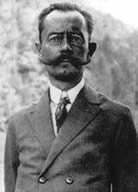
The world is an absolute game of My absolute Will.
Ladislav Klíma was born August 22, 1878, in the western Bohemian town of Domažlice. His father was a fairly well-to-do lawyer.
At first a top student, he became steadily more rambunctious (he lost two brothers, both sisters, his mother and grandmother during his
youth), and in 1895 he was expelled from gymnasium, and all the schools in the Austrian monarchy, for insulting the ruling Habsburg dynasty.
He attended school in Zagreb at his father's behest, but came home after only half a year resolved never to subject himself to formal
education again. Adamantly refusing to engage in any sort of "normal" life as well, he lived alternately in the Tyrol, Železná Ruda
in the Šumava Mountains, Zurich, and Prague, never seeking permanent employment, burning through any money he had inherited and living
off the occasional royalty or the sporadic largesse of his friends. He settled in Prague's Smíchov district where he wrote his first work
in 1904, The World as Consciousness and Nothing (published anonymously and at his own expense), in which he makes the case that
"the world" is just a fiction. His major inspirations were Berkeley, Schopenhauer, Nietzsche, and the Czech symbolist poet Otokar Březina.
Klíma's philosophy has been called radical subjective idealism, whereby the absolute subject creates all reality (and by fully understanding
their essence become the creator of their own divinity), which he developed into the concepts of egosolism and deoessence. These themes are
also explored in his fiction, chief among which are The Sufferings of Prince Sternenhoch
and Glorious Nemesis. His other major philosophical works are compilations of shorter texts :
Tractates and Dictations (1922) and A Second and Eternity (1927). While only part of Klíma's oeuvre was published during his
lifetime, numerous manuscripts were edited and collected posthumously — stories, novels, plays, and a copious correspondence (it is estimated
that Klíma, in a fit of disgust, destroyed the better part of his unpublished manuscripts). And though his writing was marginalized and suppressed
by the communist regime for decades, it still managed to inspire a generation of underground artists and dissident intellectuals with its vision
of one's innate ability to achieve inner freedom, to pursue spiritual sovereignty through deoessence. As Jan Patocka put it : "He was our first,
untimely absurdist thinker." Klíma died of tuberculosis on April 19, 1928, and is buried in Prague's Malvazinky Cemetery.